

Multi-factorial diseases require a multi-target lever
Transcription factors present an opportunity for real progress in tackling neurodegeneration

Neurodegeneration is one of the biggest areas of unmet medical need in human health. The numbers around Alzheimer’s disease (AD) alone are sobering – a growing epidemic, in part driven by the very healthcare advances that have extended human life. Global dementia cases are projected to almost triple by 2050, rising from 57 million in 2019 to over 150 million1. We are living longer, but not always better.
There is no shortage of clinical activity in neurodegeneration but, for simplicity, we will focus on AD in this article. There are around 70 new chemical or biological entities currently in clinical trials for AD, excluding repurposing opportunities and those which could be classed as symptomatic rather than disease-modifying2.
By that measure, ambition is not lacking. However, if you look at the underlying data, some troubling patterns begin to emerge in the quest to deliver meaningful therapies for patients.
The problem with single-target approaches
The first notable pattern is narrow mechanistic focus. Many late-stage projects target a single mechanism, often the reduction of protein aggregates (Figure 1). Very few trials address more than one feature of the disease, despite the reality that AD is multifactorial in nature with multiple hallmarks and multiple stages3. Focussing on one hallmark in one drug will likely result in the need to dose agents in combination, making already tough routes to clinic even tougher4. A single drug that addresses multiple factors could be more efficacious and be more clinically tractable.
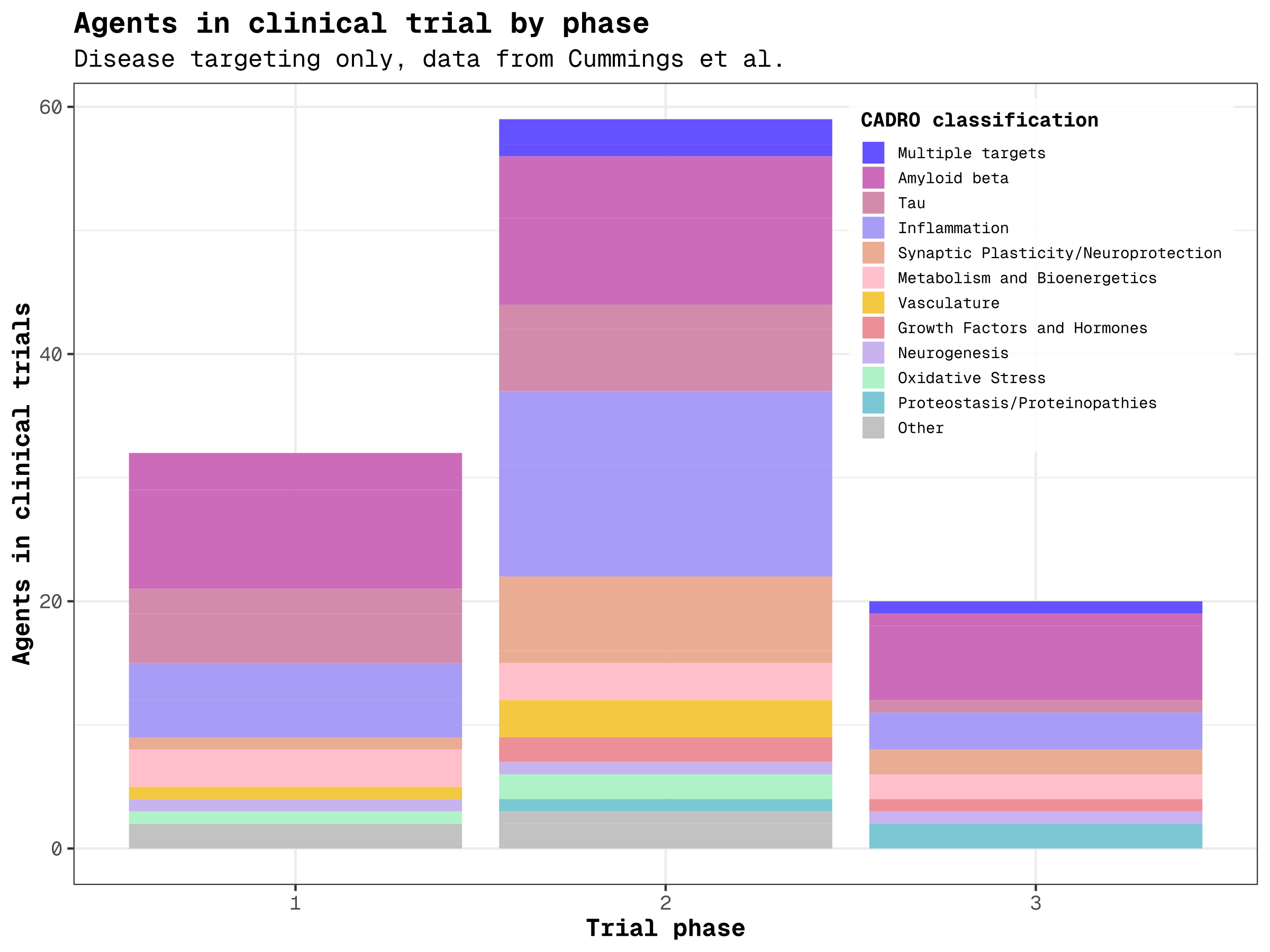
The second issue is herding56. Several projects pursue the same mechanism, reflecting a lack of risk-taking among investors. If one drug in this class fails, it is more likely that others will fail too. And the largest cohort of drugs in clinical trials for Alzheimer’s are targeting one mechanism – removal of β-amyloid protein plaques. This concentrates resources in a few well-trodden corridors while leaving large swathes of biology unexplored.
Then there is the question of where these investigational projects originate. As we explored in our previous post, most drug discovery programmes begin with a single protein target chosen from the scientific literature. But the literature is not an objective map. It is a human-made repository of information, shaped by funding biases, citation prestige and the availability of prior tools, not what best explains disease biology in real patients. It is also not always reproducible in the case of biological experiments7.
“To every complex problem there is a solution that is clear, simple and wrong.” — H. L. Mencken
A more recent trend in drug discovery has been to de-risk biology by only selecting protein targets that are directly linked to the disease in question by human genetic mutational evidence. If naturally occurring mutations in the protein (or more recently, in the promoters of the protein in non-coding DNA) lead to an increase or decrease in disease occurrence or severity, then this is taken as good validation that modulation of the protein (in the correct direction) will have a beneficial effect in humans.
This is validated by increased success rates in clinical trials, but an unintended consequence is that it both reduces the diversity of approaches pursued while at the same time promoting single target-based approaches.
For example, in AD, as well as the many approaches to directly inhibiting β-amyloid (Figure 1), TREM2 is strongly genetically linked to microglia dysfunction and yet AL002 (Alector/AbbVie), a humanised agonist anti‑TREM2 monoclonal antibody, failed to meet its endpoints in a Phase II trial despite demonstrating target engagement89. In Parkinson’s disease (PD) LRRK2 inhibition is a popular approach with four compounds already tested in early-stage human trials with no severe safety effects, but no data yet reported on disease progression. LRRK2 is strongly genetically linked to forms of PD and there are many such projects also reported in discovery.
We have to ask the question, is modulation of a single target, even if genetically validated, enough to have a useful disease modulation? For a multifactorial disease – one characterised by β-amyloid deposits, tau tangles, neuroinflammation and much else besides – influencing a single factor may simply not move the needle.
However, it’s difficult to deliberately design a drug to target two or more proteins. It’s next to impossible with small molecules (there are isolated cases10), potentially feasible for oligonucleotides, and has been robustly demonstrated clinically only in bispecific antibodies – a class with well-known limitations for CNS applications, including restricted passage to intracellular environments and through the blood-brain barrier.
If we want to come up with medicines for AD and other multifactorial diseases (such as Parkinson’s and ALS in the neuro space) with a better chance of working, we need a different approach entirely.
“Give me a lever long enough and a fulcrum on which to place it, and I shall move the world.” – Archimedes
Transcription factors as multi-target levers
There is one target class of proteins that can be considered to modulate multiple targets – transcription factors (TFs). Each TF governs the expression of its own set of gene targets, meaning that modulating a single TF influences multiple protein targets simultaneously. They are, in effect, master regulators – biological levers for the programmes that define cell identity, stress response, and pathological states.
This makes TFs a uniquely powerful entry point for addressing multifactorial disease. And working with them offers several distinct advantages (and some caveats, which we will address).
We can read disease biology directly through TF activity. TFs control disease signatures, disease signatures can be obtained from multiple sources, and the control is readily calculated by Gene Regulatory Networks (GRN). Through GRN analysis – computational models that map the relationships between TFs and their downstream gene targets – we can determine which TFs are driving the disease state in any given sample, whether that is a single cell or a whole organ. We can do this across different genetic backgrounds and disease severities. This gives us an unbiased, bottom-up readout of disease biology, not filtered through the lens of what the literature already knows.
We can profile the disease relevance of each TF’s targets. Because we can evaluate the full set of downstream genes for any given TF, we can assess how many are disease-relevant – for example, by cross-referencing GWAS linkage data – and identify which TFs offer the best combination of disease relevance and manageable off-target risk. Interestingly, we see a two-fold increase in target genes with OpenTarget AD association in prioritised TFs from our GRN selections. Chromatin state analysis allows us to further estimate cell-type selectivity, and oncogenicity data combined with TF activity prediction can be used to predict potential toxicity risks. TFs are highly information-rich targets, and that depth of information makes them unusually amenable to principled prioritisation.
TF modulation does not require direct binding. Many upstream protein targets and signalling pathways act as switches for TF activation state. Because we understand these upstream networks, we can identify drug molecules that modulate a given TF indirectly, significantly expanding the druggable space and allowing us to take advantage of well-characterised upstream biology.
Mapping disease progression with TFs
Understanding TF activity is not only useful for reaching multiple targets. It also provides a new lens through which to understand how disease evolves over time – a particularly useful perspective in neurodegeneration.
In AD, a major goal is to diagnose disease onset as early as possible, ideally even before symptoms occur. Advances in biomarkers, aided by AI, have brought this opportunity tantalisingly closer.
By applying GRN analysis to post-mortem brain samples from patients at different stages of disease – characterised by their Braak score, a measure of neurofibrillary tangle distribution – we can track not only which TFs are driving the disease, but how that picture shifts as it progresses (Figure 2). Scripta’s in-house analysis of key driver TFs across post-mortem samples11 reveals a striking change in the relative importance of individual TFs at different disease stages. Combined with patient genotyping, this provides a richer and more dynamic picture of disease progression than any single-protein approach can offer.
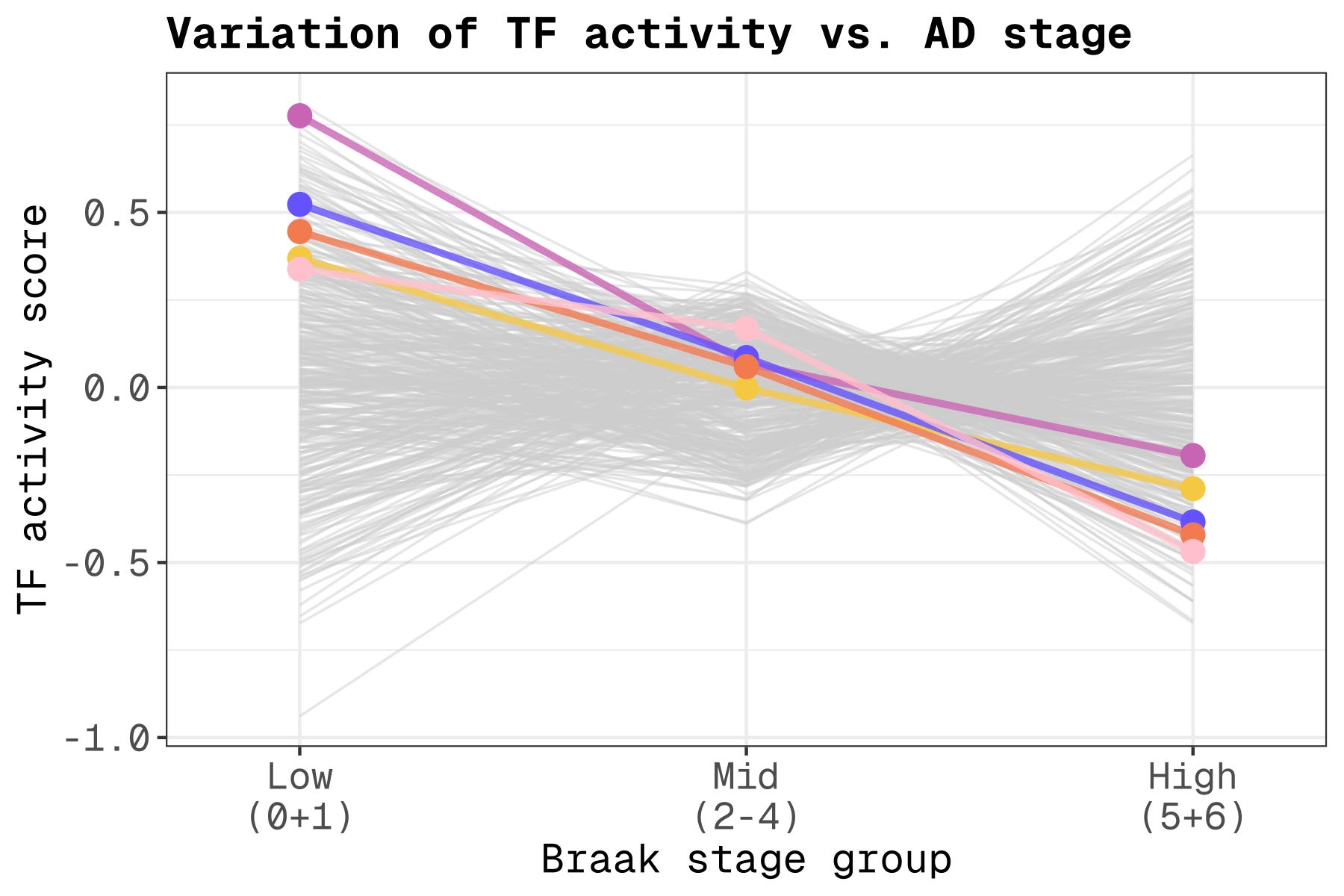
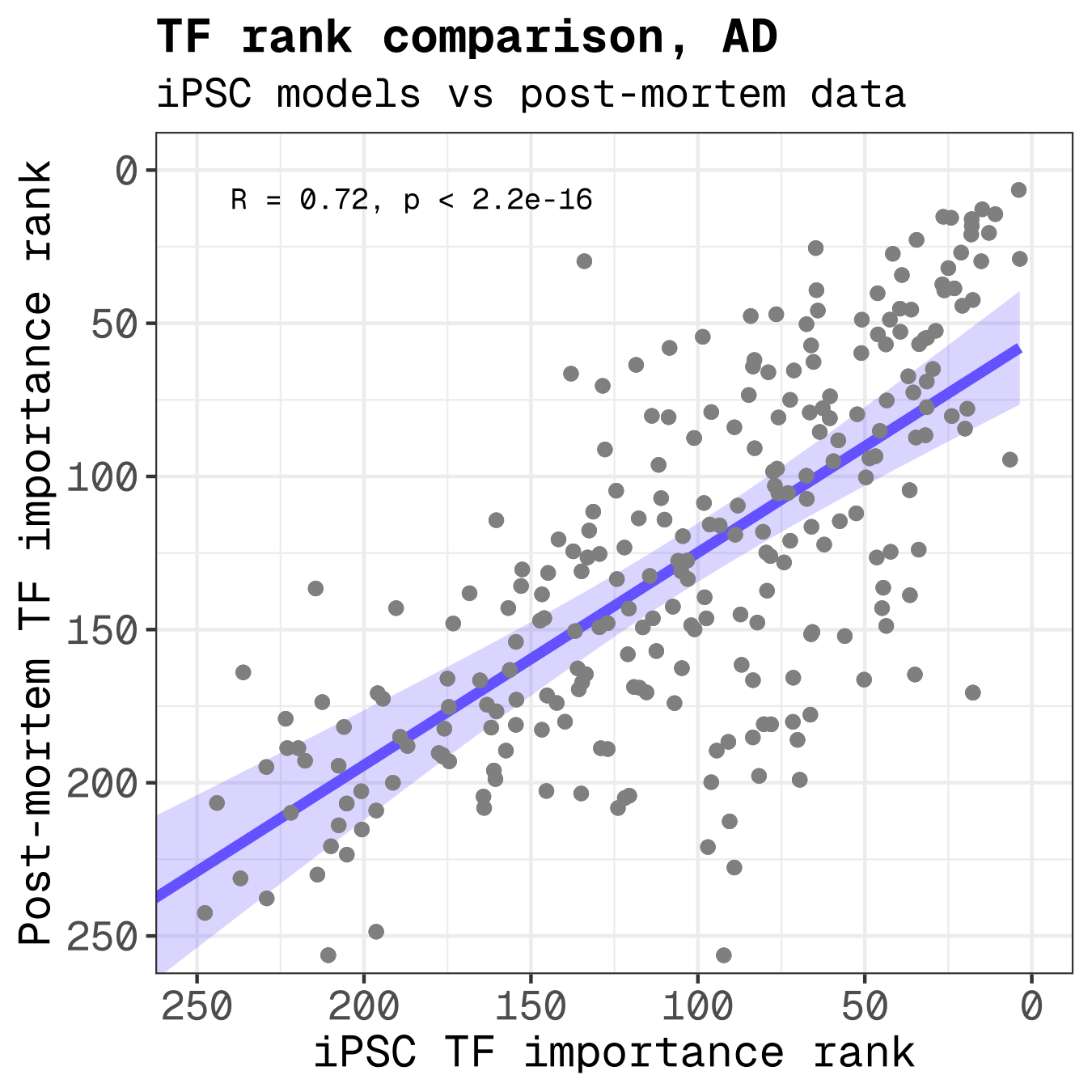
Of course, post-mortem data is subject to a number of caveats. The circumstances surrounding end of life in AD patients are complex and will inevitably affect the transcriptome. To address this, we can validate GRN findings in patient-derived iPSC (induced pluripotent stem cell) models. These serve a dual purpose: they help confirm observations from post-mortem tissue (see Figure 3 for an example of correlation), and they ensure that the TF of interest has a relevant, disease-driven in vitro assay to validate against. This is a closed-loop approach that is rarely available to conventional drug discovery programmes, which are typically reliant on whatever validation assay happens to exist for the chosen target.
From mapping to medicines
Scripta is not only pursuing a TF-centric disease mapping approach as outlined above, but has a technology platform set up to discover therapeutics that modulate any given TF in the desired manner (activation or inhibition) without the constraints that have historically made TFs appear undruggable.
The combination of TF-based disease mapping and the multi-target properties of TF biology is, we believe, a recipe for finding new therapeutics which truly have disease modifying effects on multifactorial diseases.
We are starting with Alzheimer’s disease and neurodegeneration, where the unmet need is urgent and the biology is ripe for a reset. But the logic extends far beyond AD. TF dysregulation underpins cancer, fibrosis, inflammatory disease, and many other conditions. The challenge may simply be deciding where to go next.
Nichols E. et al, Estimation of the global prevalence of dementia in 2019 and forecasted prevalence in 2050: an analysis for the Global Burden of Disease Study 2019. The Lancet Public Health, 2022; 7, e105-e125. doi: 10.1016/S2468-2667(21)00249-8
Cummings J.L. et al, Alzheimer’s disease drug development pipeline: 2025, 2025;11:e70098. doi: 10.1002/trc2.70098
Iqbal K. et al, Alzheimer Disease, a Multifactorial Disorder Seeking Multi-therapies, Alzheimers Dement. 2010 Sep;6(5):420–424. doi: 10.1016/j.jalz.2010.04.006
D. Angioni, et al., 2025. Challenges and opportunities for novel combination therapies in Alzheimer’s disease: a report from the EU/US CTAD Task Force. The Journal of Prevention of Alzheimer’s Disease. Volume 12, Issue 6 doi: 10.1016/j.tjpad.2025.100163
Fougner C, et al., Herding in the drug development pipeline. Nat Rev Drug Discov. 2023 Aug;22(8):617-618. doi: 10.1038/d41573-023-00063-3
Spring L, et al., First-in-class versus best-in-class: an update for new market dynamics. Nat Rev Drug Discov. 2023 Jul;22(7):531-532. doi: 10.1038/d41573-023-00048-2
Reality check on reproducibility. Nature 2016 533, 437. doi: 10.1038/533437a
Ma, Y-N. et al, The potential and challenges of TREM2-targeted therapy in Alzheimer’s disease: insights from the INVOKE-2 study, Front Aging Neurosci. 2025 Apr 25:17:1576020. doi: 10.3389/fnagi.2025.1576020
Mummery C.J. et al, The TREM2 agonistic antibody AL002 in early Alzheimer’s disease: a phase 2 randomized trial. Nat Med 2026. doi: 10.1038/s41591-026-04273-1
Besnard J. et al, Automated design of ligands to polypharmacological profiles, Nature. 2012 Dec 13;492(7428):10.1038/nature11691. doi: 10.1038/nature11691
Mathys, H. et al. Single-cell multiregion dissection of Alzheimer’s disease. Nature 2024, 632, 858–868. https://doi.org/10.1038/s41586-024-07606-7